Santorini: Fira, Oia or the east coast beaches, where to stay
The villages perched on the caldera, Fira, Imerovigli and Oia, have the view over the volcano but plenty of steps. Kamari and Perissa, on the east side, are simpler and sit on black sand beaches.
By Rédaction Le Long-CourrierChecked on 14 November 2026Report an errorContains affiliate links
When to go to Santorini: the climate month by month
Best months : June, July, September, that is the three months closest to 26 °C in the daytime with the fewest rainy days.
- Highs
- 27 °C
- Lows
- 22 °C
- Rain
- 6 mm
- Rainy days
- 1
Measured averages : Open-Meteo (ERA5 reanalysis), 2015-2024 averages.
Where to stay
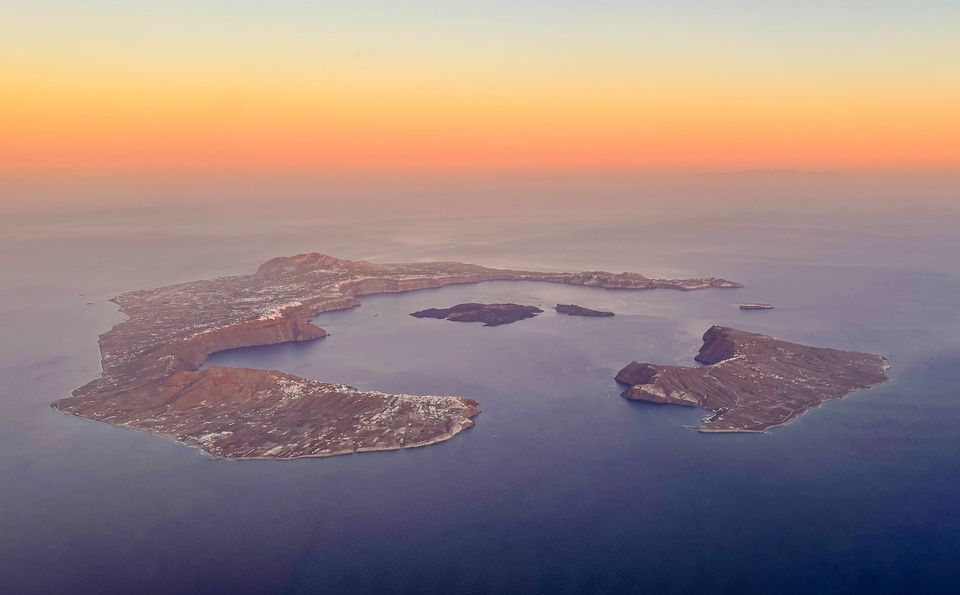
Santorini has two sides. To the west, the villages cling to the top of the caldera cliff, with views over the sea and the volcano. To the east, the coast slopes gently down to black sand beaches. The choice is between the view and convenience.
Fira, the capital, is the most practical base: all the island's buses leave from here, and restaurants, bars and shops fill the lanes along the cliff edge. During the day, when cruise passengers come up from the old port, the centre is very crowded. Firostefani and Imerovigli, which extend Fira to the north, are quieter and have the same view; Imerovigli sits on the highest point of the ridge, facing Skaros rock.
Oia, at the northern tip, is the most photographed village, with its white houses and blue domes. It is also the most expensive, and the most overrun at sunset. All along the caldera, hotels take some effort to reach: access is almost always by steps, something to plan for with heavy luggage or if walking is difficult.
On the east side, Kamari and Perissa line up hotels and tavernas along their black sand beaches. You sleep for less, in peace and right by the water, but without the caldera view.
What to see
The caldera is the island's great sight: the crater of a collapsed volcano, flooded by the sea and ringed by cliffs. The clifftop path linking Fira to Oia, via Firostefani and Imerovigli, follows it for about ten kilometres; set off early in the morning, as there is almost no shade. Boats also go to Nea Kameni, the volcanic islet in the middle of the bay, where you walk up to the crater, then on to the hot springs of Palea Kameni.
In Oia, the sunset draws a dense crowd every evening around the castle ruins. Below the village, steps lead down to the small bay of Ammoudi and its fish tavernas.
Akrotiri, in the south-west, is a Bronze Age town buried under ash in the eruption that formed the caldera. Its multi-storey houses are protected by a large roof. Some of the frescoes found on site are displayed at the Museum of Prehistoric Thera, in Fira. Red Beach, close by, is backed by red lava cliffs that rockfalls sometimes make dangerous.
Ancient Thira, a Greek then Roman city, occupies the summit of Messa Vouno, between Kamari and Perissa, with a view over both beaches. Inland, Pyrgos is a hilltop village of quiet lanes, at the foot of Mount Profitis Ilias, the island's highest point.
Where and what to eat
The volcanic soil and the lack of water produce distinctive ingredients. Fava, a purée of yellow split peas grown on the island, served with onion and a drizzle of olive oil, is on the menu of almost every taverna. Tomatokeftedes are fritters made with small, very fragrant Santorini tomatoes. You will also find white aubergine, milder than the purple kind, and chlorotyri, a fresh goat's cheese.
The vineyards are the island's other source of pride. The vines grow close to the ground, coiled into a basket shape to shelter from the wind. They produce assyrtiko, a dry, mineral white, and vinsanto, a sweet wine made from sun-dried grapes. Several wineries around Pyrgos and Megalochori are open to visitors.
For fish, the tavernas in Ammoudi bay, below Oia, and those on the seafronts of Kamari and Perissa are the simplest options. In Fira, restaurants with a caldera view charge for the panorama.
Practical tips
The airport is on the east coast, near Kamari. Ferries from Piraeus and the other Cyclades dock at the port of Athinios, at the foot of the cliff, from where a winding road climbs to Fira. Fira's old port is used by cruise ships and excursion boats: you get back up to the village by cable car or a long staircase.
The bus network runs from Fira to Oia, Kamari, Perissa, Akrotiri and the port. A car helps for the inland villages, but parking is difficult in Fira and Oia in summer. Be wary of agencies that only rent quad bikes and motorbikes: read the contract and the insurance before signing.
Tap water comes largely from desalination: drink bottled water. On the staircase at Fira's old port, donkeys still carry tourists; it is better to take the cable car or walk up.
When to go
May, June, September and October are the best months: sunshine is guaranteed, the sea is pleasant from early summer and the villages stay liveable. July and August are the hottest and by far the busiest, with prices at their peak and the meltemi, a north wind that is often strong and makes the sea rough.
In April and late October it is mild but the sea stays cool. From November to March the island is very quiet: there is more rain, the wind blows, and many hotels and restaurants close, especially in Oia and on the beaches.
Frequently asked questions
Where should I stay in Santorini on a first visit?
In Fira, the capital, for the buses, the restaurants and the view over the caldera, or in Firostefani and Imerovigli, just to the north, which are quieter. Oia is the most beautiful but the most expensive. For the beach and lower prices, Kamari or Perissa, on the east side.
What are the must-sees in Santorini?
The caldera, on foot along the clifftop path between Fira and Oia or by boat to the Nea Kameni volcano, the sunset at Oia, the prehistoric town of Akrotiri, Ancient Thira on its mountain and the village of Pyrgos.
When is the best time to go to Santorini?
In May-June or September-October: the weather is good, the sea is pleasant and the crowds stay bearable. July and August are hot, windy and very busy. From November to March, many hotels and restaurants close.
Do I need to rent a vehicle in Santorini?
It is not essential: buses run from Fira to Oia, the beaches and Akrotiri. A car helps for the inland villages and the beaches in the south. Avoid agencies that only rent quad bikes and motorbikes, and read the insurance carefully.
What should I try in Santorini?
Fava, a purée of yellow split peas grown on the island, tomatokeftedes, fritters made with small local tomatoes, and white aubergine. For wine, assyrtiko, a dry white from the volcanic soil, and vinsanto, a sweet wine.